How-to
How to make Neapolitan-style pizza dough
Published
Note: This page contains affiliate links. If you buy through them we may earn a commission at no extra cost to you. Learn more
In short
For four 250 g dough balls at 62 % hydration, mix 606 g Tipo 00 or strong white bread flour, 376 g cold water, 17 g fine salt and about 1.2 g dried yeast. Knead until smooth, rest for an hour or two, divide into 250 g balls and cold prove in the fridge for 24 to 72 hours. Bring to room temperature for a few hours before stretching.
Products for this job
Compare all 7 productsGeorge Foreman dual fuel: gas or wood pellets, 500°C
Check price on AmazonAffiliate linkDeliVita Diavolo: gas, 450°C, temperature gun included
Check price on AmazonAffiliate linkGino D'Acampo Modena: 14 inch gas oven with thermometer
Check price on AmazonAffiliate link
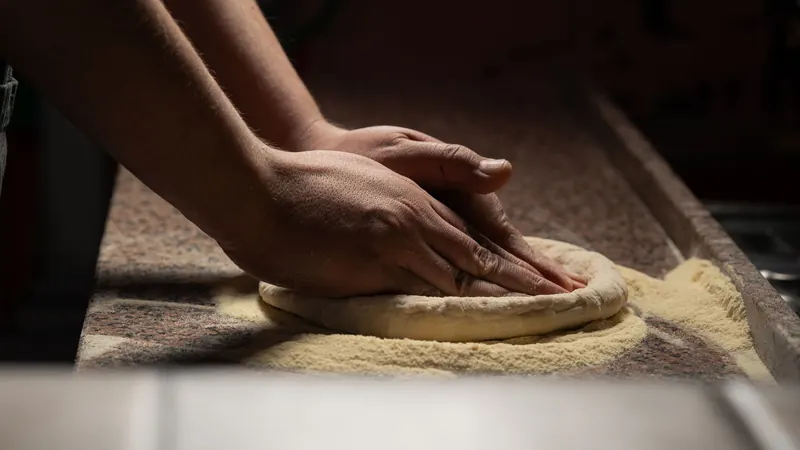
Neapolitan-style pizza uses just four ingredients: flour, water, salt and yeast. The skill is in the proportions and the time you give the dough. This recipe uses baker's percentages, where every ingredient is a share of the flour weight, so you can scale it up or down easily. It is written for UK kitchens with ingredients you can find in a supermarket, and it suits a hot outdoor pizza oven or an electric pizza oven. Use digital scales: cups and spoons are not accurate enough for small amounts of salt and yeast.
Ingredients and baker's percentages
In baker's percentages, the flour is always 100 %. Water at 62 % means 62 g of water for every 100 g of flour. Salt at around 2.8 % and dried yeast at around 0.2 % suit a slow, cold prove. These are the defaults in our pizza dough calculator, which works out exact grams for any number and size of dough balls.
One 250 g dough ball
- Flour
- 151.5 g · 100 %
- Water
- 93.9 g · 62 %
- Salt
- 4.2 g · 2.8 %
- Yeast
- 0.3 g · 0.2 %
| Ingredient | Baker's % | Grams |
|---|---|---|
| Tipo 00 or strong white flour | 100 % | 606 g |
| Cold water | 62 % | 376 g |
| Fine salt | 2.8 % | 17 g |
| Dried yeast | 0.2 % | 1.2 g (or about 3.6 g fresh yeast) |
Choosing flour and hydration
Italian Tipo 00 pizza flour is finely milled and gives the soft, puffy crust associated with Neapolitan pizza. UK strong white bread flour also works well and is easier to find. It usually has a little more protein, so the dough may feel slightly firmer and chewier. Plain flour is too weak for a stretchy dough.
Hydration between 60 and 65 % is a good range. At 60 % the dough is firmer and easier to handle, which suits beginners. At 65 % it is softer, stickier and gives a lighter crust, but takes more practice to shape. Start at 60 or 62 % and increase as you get confident. If the dough fights you, our pizza dough tearing or sticky guide can help.
| Hydration | Flour | Water | Salt |
|---|---|---|---|
| 60 % | 613 g | 368 g | 17 g |
| 62 % | 606 g | 376 g | 17 g |
| 65 % | 595 g | 387 g | 17 g |
Mixing and kneading
The short rest after mixing lets the flour absorb the water, which makes kneading easier. Keeping salt and yeast apart at the start is a common habit, as concentrated salt can slow the yeast.
- 1
Pour almost all the water into a large bowl and dissolve the yeast in it.
- 2
Add about two thirds of the flour and stir to a thick batter.
- 3
Dissolve the salt in the remaining water and add it, then add the rest of the flour.
- 4
Mix until there is no dry flour left, then cover and rest for 15 to 20 minutes.
- 5
Knead by hand for 8 to 10 minutes, or 5 to 8 minutes with a stand mixer on low, until smooth and slightly springy.
- 6
Cover the bowl and leave at room temperature for one to two hours.
Balling and cold proving
Tip the dough onto a lightly floured surface and divide it into 250 g pieces with a scraper and scales. Shape each into a tight ball by folding the edges under and rolling it against the worktop with a cupped hand until the surface is smooth. A 250 g ball makes a pizza of roughly 12 inches; see pizza dough ball sizes for other diameters.
Place the balls in a lightly oiled lidded container or individual tubs with room to spread, and put them in the fridge for 24 to 72 hours. The cold slows the yeast, so flavour develops without the dough over-proving. Our guide on how long pizza dough keeps covers storage and freezing.
Bringing the dough back up to temperature
Take the dough balls out of the fridge around two to four hours before cooking, still covered, so they warm up and relax. Cold dough springs back when you stretch it. The balls are ready when they have softened, spread a little and feel airy when pressed gently.
Flour the worktop, lift a ball with a scraper and press from the centre outwards, leaving a rim for the crust. Stretch it over your knuckles rather than using a rolling pin, which flattens the air out of the crust. Then top it lightly and launch. For oven technique, see how to use an outdoor pizza oven. If you are choosing an oven to cook it in, our best outdoor pizza ovens and best electric pizza ovens for indoors guides list current options.
Frequently asked questions
Can I use strong white bread flour instead of 00? Yes. UK strong white flour makes good pizza dough. The crust is often a little chewier than with Tipo 00, but the method is the same.
Can I make the dough on the same day? Yes. Use a little more yeast and leave it at room temperature for several hours until it has roughly doubled. Cold proving gives more flavour, but a same-day dough still works.
What hydration should a beginner use? Start around 60 to 62 %. The dough is easier to shape, and you can move up towards 65 % once stretching feels comfortable.
How much dough do I need per pizza? About 250 g for a roughly 12 inch Neapolitan-style pizza. Use our dough calculator for other sizes and quantities.
What you need
- Check price on AmazonAffiliate link
George Foreman dual fuel: gas or wood pellets, piezo ignition
- Check price on AmazonAffiliate link
DeliVita Diavolo: compact 12 inch gas oven, 450°C
From: Best 12 inch pizza ovens
- Check price on AmazonAffiliate link
Sage Smart Oven Pizzaiolo: 400°C, Element iQ, 2,250 W