Guide
Pizza dough ball sizes for 10, 12 and 16 inch pizzas
Published
Note: This page contains affiliate links. If you buy through them we may earn a commission at no extra cost to you. Learn more
In short
As a starting point for a Neapolitan-style crust, use about 170 to 190 g of dough for a 10 inch pizza, 240 to 270 g for a 12 inch and 420 to 470 g for a 16 inch. Go lighter for a thin, crisp base and heavier for a thicker crust. A 250 g ball for a 12 inch pizza is the most common standard.
Products for this job
Compare all 6 productsDeliVita Diavolo: compact 12 inch gas oven, 450°C
Check price on AmazonAffiliate linkNutriChef 30.48 cm gas oven: rotating stone, 9.9 kg
Check price on AmazonAffiliate linkGeorge Foreman 12 inch pellet oven: 10.8 kg with carry bag
Check price on AmazonAffiliate link
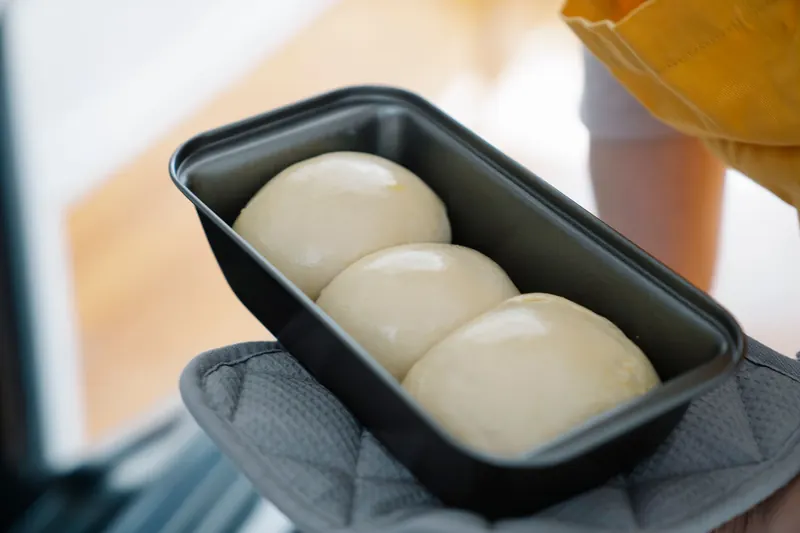
Getting the dough ball size right means your pizzas stretch to the size of your oven without tearing in the middle or leaving a thick, doughy base. The right weight depends on two things: the diameter you want and how thick you like the crust. Because pizza area grows with the square of the diameter, a 16 inch pizza needs far more than a third more dough than a 12 inch. This guide gives a chart in grams, explains the maths and shows how to plan a batch with our pizza dough calculator.
Dough ball size chart
These weights are starting points, not fixed rules. Flour, hydration and how much rim you leave all make a difference. If your pizzas come out thinner or thicker than you like, adjust by 10 to 20 g next time.
Thin and crisp bases are stretched almost to the edge with very little rim, so they need less dough for the same diameter. Neapolitan-style pizzas have a soft centre and a puffy rim, which takes a bit more. Thicker crusts, including pan-style pizzas baked in a tin, need the most. Higher hydration doughs also stretch further, so at 65 % you may find the lower end of each range is enough.
| Pizza size | Area | Thin and crisp | Neapolitan-style | Thicker crust |
|---|---|---|---|---|
| 10 inch (25 cm) | 78.5 sq in | 140 to 160 g | 170 to 190 g | 210 to 240 g |
| 12 inch (30 cm) | 113.1 sq in | 200 to 220 g | 240 to 270 g | 300 to 340 g |
| 14 inch (36 cm) | 153.9 sq in | 270 to 300 g | 320 to 360 g | 410 to 460 g |
| 16 inch (41 cm) | 201.1 sq in | 350 to 400 g | 420 to 470 g | 530 to 600 g |
Why a bigger pizza needs much more dough
The area of a circle is pi times the radius squared. A 12 inch pizza has an area of about 113 sq in, while a 16 inch pizza has about 201 sq in. That is nearly 78 % more pizza, even though the diameter is only a third bigger. So if 250 g works for your 12 inch pizza, you need roughly 445 g for the same thickness at 16 inches.
The same maths explains why two 12 inch pizzas, at around 226 sq in together, give a little more pizza than one 16 inch. Try your own combinations with our pizza size comparer.
Matching dough to your oven
Most compact portable ovens have a stone of about 12 to 13 inches, so 240 to 270 g balls are the natural fit. Leave a little margin: a pizza that touches the walls or sits right against the flame is hard to turn and burns easily. Larger 16 inch ovens let you stretch 420 to 470 g balls to full size, or cook smaller pizzas with more space to turn.
If you are choosing an oven, our 12 inch vs 16 inch pizza oven comparison and best 12 inch pizza ovens guide cover the trade offs. For a full range of sizes, see the best outdoor pizza ovens.
Electric countertop ovens and home ovens with a pizza stone often have smaller cooking areas too. Measure the usable stone or deck and aim for a pizza about an inch smaller, then pick the weight from the chart for that diameter.
Planning a batch with baker's percentages
Once you know the ball weight and the number of pizzas, the total dough weight is simply balls multiplied by weight. Six 250 g balls need 1,500 g of dough. The dough calculator then splits that into flour, water, salt and yeast using baker's percentages.
At the calculator's defaults of 62 % hydration, 2.8 % salt and 0.2 % dried yeast, one 250 g ball works out at about 152 g flour, 94 g water, 4 g salt and 0.3 g dried yeast. Small amounts like this are hard to weigh, which is why most people make at least four balls at a time. Our Neapolitan-style dough recipe walks through the method.
One 250 g dough ball
- Flour
- 151.5 g · 100 %
- Water
- 93.9 g · 62 %
- Salt
- 4.2 g · 2.8 %
- Yeast
- 0.3 g · 0.2 %
| Batch | Total dough | Flour at 62 % | Water |
|---|---|---|---|
| 4 x 250 g | 1,000 g | 606 g | 376 g |
| 6 x 250 g | 1,500 g | 909 g | 564 g |
| 4 x 450 g | 1,800 g | 1,091 g | 676 g |
Weighing and shaping tips
Divide the dough with a scraper on digital scales rather than by eye. Small differences add up when every pizza needs to fill the same stone. Trim and add small pieces until each ball is within a few grams, then shape it tightly so the added piece is tucked into the base.
Allow a little extra for loss: a few grams stick to the bowl and worktop. Many people add around 2 to 3 % to the total batch to cover this. If dough tears when stretched, the ball may be too small for the size you are aiming for, or simply too cold. See pizza dough tearing or sticky for fixes.
Frequently asked questions
How big should a dough ball be for a 12 inch pizza? Around 240 to 270 g for a Neapolitan-style pizza, with 250 g the most common choice. Use about 200 to 220 g for a thinner base.
How much dough for a 16 inch pizza? Roughly 420 to 470 g for a Neapolitan-style crust, because a 16 inch pizza has nearly 80 % more area than a 12 inch.
What dough ball size suits a compact portable oven? Most compact ovens suit 12 inch pizzas, so 240 to 270 g balls are a good fit. Check your oven maker's guidance for the stone size.
Can I freeze dough balls of different sizes? Yes. Weigh and shape them first, then freeze individually. See how long pizza dough keeps for storage times.
What you need
- Check price on AmazonAffiliate link
DeliVita Diavolo: compact 12 inch gas oven, 450°C
From: Best 12 inch pizza ovens
- Check price on AmazonAffiliate link
George Foreman dual fuel: gas or wood pellets, piezo ignition
- Check price on AmazonAffiliate link
Jamie Oliver by Tefal: hand-turned rotating stone, 10.9 kg
From: Best portable pizza ovens for camping and taking to friends