Fix
Pizza dough tearing or too sticky
Published
Note: This page contains affiliate links. If you buy through them we may earn a commission at no extra cost to you. Learn more
In short
Dough that tears is usually under-proved, too cold or not developed enough, so the gluten is tight and snaps. Dough that sticks to everything is usually too wet for your flour or has been worked with too little flour on the bench. Give dough balls more time at room temperature, lower the water slightly if it is always sticky, and stretch with floured knuckles rather than a rolling pin.
Products for this job
Compare all 6 productsDeliVita Diavolo: compact 12 inch gas oven, 450°C
Check price on AmazonAffiliate linkNutriChef 30.48 cm gas oven: rotating stone, 9.9 kg
Check price on AmazonAffiliate linkGeorge Foreman 12 inch pellet oven: 10.8 kg with carry bag
Check price on AmazonAffiliate link
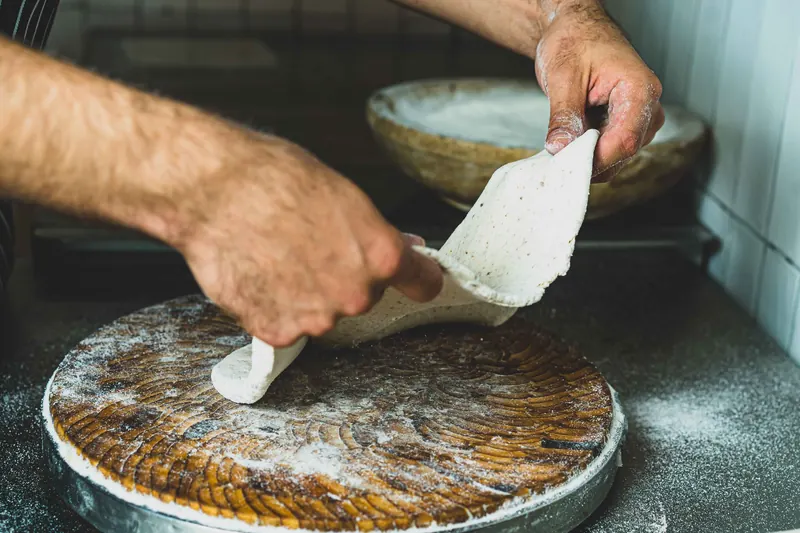
Good pizza dough should feel soft, smooth and slightly tacky, and stretch into a thin base without tearing. When it rips in the centre, springs back to a small disc, or glues itself to your hands and the bench, something in the recipe or timing is off. Most problems come down to four things: how much water is in the dough, how well the gluten has developed, how long it has proved and what temperature it is when you stretch it. This guide goes through each, with simple fixes you can try on the next batch.
Too sticky: hydration and handling
Hydration is the weight of water as a percentage of the flour. Many Neapolitan style recipes sit around 60 to 65 percent. Higher hydration doughs, 70 percent and above, are softer and stickier and take more practice. If your dough always sticks, drop the water by a few percent and see how it feels. Our dough calculator works this out in grams for any number of balls.
Flour matters too. Strong bread flour and Italian 00 flour for pizza absorb water differently, so the same recipe can feel wetter with one bag than another. Weigh rather than use cups. When shaping, use a light dusting of flour or semolina on the bench and your hands. Wet hands work for some, but too much flour worked into the ball makes it tough.
One 250 g dough ball
- Flour
- 151.5 g · 100 %
- Water
- 93.9 g · 62 %
- Salt
- 4.2 g · 2.8 %
- Yeast
- 0.3 g · 0.2 %
Tearing: under-developed or under-proved dough
Gluten gives dough its stretch. If the dough was not kneaded enough, the gluten network is weak and tears easily. Knead until smooth and elastic, or use a series of stretch and folds over an hour or so. A good test is gently stretching a small piece thin enough to see light through before it tears.
Under-proved dough is tight and springy. The gluten has not relaxed, so it fights back and tears where you stretch it hardest. Over-proved dough has the opposite problem: it is slack, weak and full of big bubbles that burst into holes. Look for balls that have grown, feel soft and puffy, and spring back slowly when pressed with a floured finger.
| Sign | Likely cause | Fix |
|---|---|---|
| Springs back, tears in centre | Under-proved or cold | More time at room temperature |
| Sticky, sags, holes | Over-proved or too wet | Shorter prove, less water |
| Tears even when relaxed | Under-kneaded | Knead longer or add folds |
| Sticks to the bench | Too little dusting | Light semolina or flour |
How long should pizza dough rise?
It depends on yeast and temperature. A same day dough with more yeast may be ready in a few hours at room temperature. Many cooks prefer a cold prove in the fridge for 24 to 72 hours with less yeast, which gives more flavour and easier stretching. Our how long pizza dough keeps article covers storage and timings in more detail.
Whatever the method, cold dough from the fridge needs time to warm. Take dough balls out roughly 2 to 4 hours before cooking, depending on the room, and keep them covered so they do not dry out and form a skin. Stretching cold dough is one of the most common causes of tearing.
Dough balls and stretching without holes
Divide the dough into balls after the first rise or as you go into the fridge. A ball of around 230 to 270 g suits a 10 to 12 inch pizza, and our pizza dough ball sizes guide gives more sizes. Shape each ball by tucking the surface under itself until it is tight and smooth, with the seam underneath.
To stretch, flour the bench, press the centre flat with your fingertips and leave a rim. Then lift the dough over your knuckles and rotate, letting gravity do the work. Avoid pulling the centre thin, as it is already the thinnest part. If the dough springs back, cover it and leave it 10 to 15 minutes, then try again.
- 1
Take balls out of the fridge 2 to 4 hours before cooking.
- 2
Dust the bench and the top of the ball.
- 3
Press from the centre out, keeping a rim.
- 4
Stretch over the knuckles, turning as you go.
- 5
Rest 10 minutes if it fights back.
- 6
Patch a small hole by pinching dough over it.
From dough to oven
Sticky dough also sticks to the peel, so getting the dough right solves two problems at once. See pizza sticking to the peel for launch tips. If you are building your kit, the best 12 inch pizza oven guide suits most home dough ball sizes, and the best outdoor pizza oven guide covers larger models. More technique is in dough and cooking.
Frequently asked questions
Why does my pizza dough stick to everything? It is usually too wet for your flour, over-proved, or handled with too little dusting. Lower the water slightly and use a light layer of flour or semolina on the bench.
Why does my pizza dough tear when I stretch it? It is often under-proved, cold from the fridge or not kneaded enough. Let it warm up and relax, and knead until smooth.
How long should pizza dough rise? A few hours at room temperature for a same day dough, or 24 to 72 hours in the fridge for a cold prove, then 2 to 4 hours out before cooking.
Should I use a rolling pin? You can, but it pushes the air out of the rim. Stretching by hand gives a lighter crust and fewer thin spots.
What you need
- Check price on AmazonAffiliate link
DeliVita Diavolo: compact 12 inch gas oven, 450°C
From: Best 12 inch pizza ovens
- Check price on AmazonAffiliate link
George Foreman dual fuel: gas or wood pellets, piezo ignition
- Check price on AmazonAffiliate link
Sage Smart Oven Pizzaiolo: 400°C, Element iQ, 2,250 W